Overview:
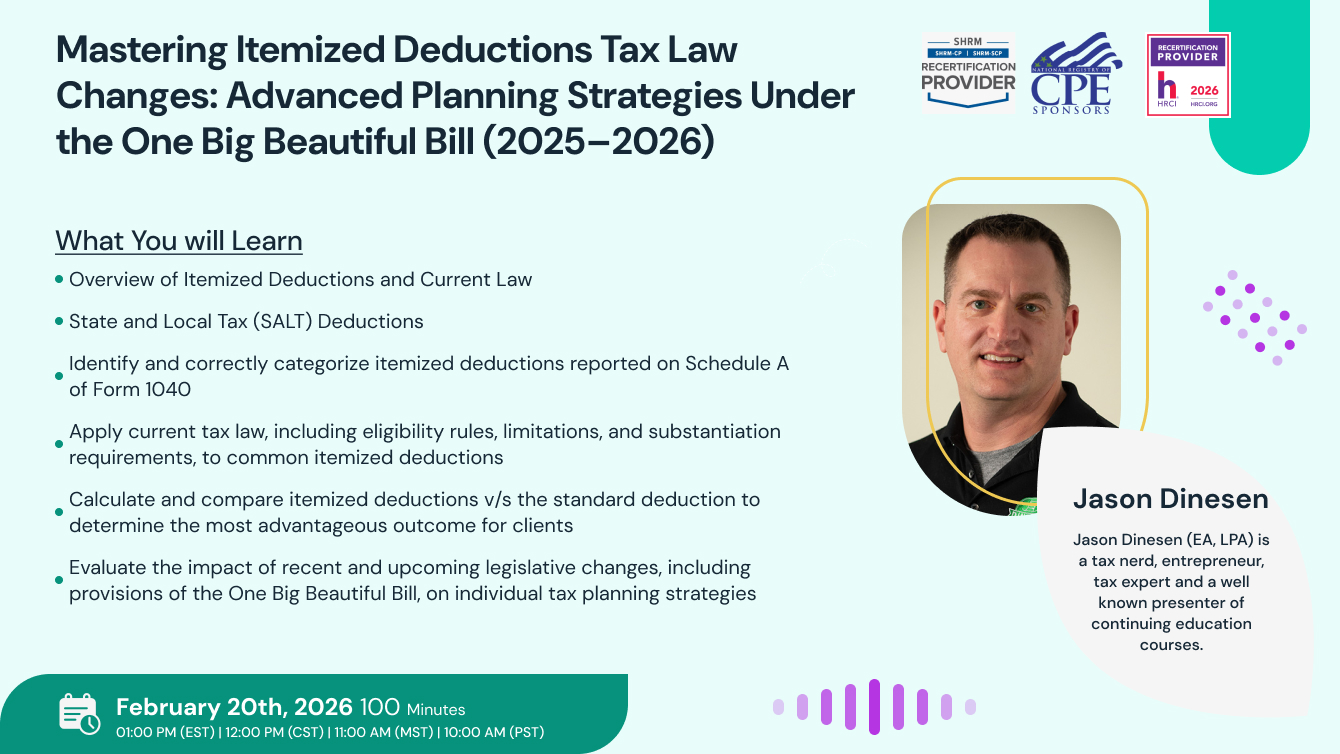
Itemized deductions remain one of the most powerful — and most frequently misunderstood — areas of individual tax planning. With major legislative changes taking effect in 2025 and 2026, including a significant increase to the SALT deduction cap and revised rules impacting charitable contributions, tax professionals must be prepared to guide clients through a rapidly shifting landscape.
This 100-minute webinar delivers a comprehensive, practical review of itemized deductions as reported on Schedule A of Form 1040. Each category of deduction is examined in detail, with a focus on eligibility, substantiation requirements, deduction limitations, and planning opportunities under current law.
Participants will gain critical insight into how the One Big Beautiful Bill reshapes itemized deduction strategy and client decision-making. Real-world case studies and calculation examples are integrated throughout the course to reinforce technical understanding and ensure participants can confidently apply the rules when advising clients. Special emphasis is placed on strategic analysis — helping practitioners determine when itemizing deductions provides a greater benefit than the standard deduction and how to proactively plan for upcoming changes in 2026.
Areas covered in this Training:
· Overview of Itemized Deductions and Current Law
· State and Local Tax (SALT) Deductions
· Identify and correctly categorize itemized deductions reported on Schedule A of Form 1040
· Apply current tax law, including eligibility rules, limitations, and substantiation requirements, to common itemized deductions
· Calculate and compare itemized deductions v/s the standard deduction to determine the most advantageous outcome for clients
· Evaluate the impact of recent and upcoming legislative changes, including provisions of the One Big Beautiful Bill, on individual tax planning strategies
Why You Should Attend:
As itemized deduction rules evolve, outdated knowledge can lead to missed planning opportunities and costly compliance errors. With significant changes to itemized deductions on the horizon, tax professionals must understand how evolving rules will affect client outcomes. This webinar equips attendees with the knowledge needed to proactively advise clients on planning strategies for 2025 and 2026, helping them adapt to new limitations, expanded deductions, and compliance requirements in order to maximize allowable tax benefits.
Suggested Attendees:
· Tax Professionals
· Certified Public Accountants (CPAs)
· Enrolled Agents (EAs)
· Attorneys and Tax Attorneys

Jason Dinesen
Jason Dinesen (EA, LPA) is a tax nerd, entrepreneur, tax expert and a well-known presenter of continuing education courses. Known for his sharp tax interpretations, he is one of the quickest to bring the analysis of the latest tax updates and IRS guidance to the professional community.
Jason has coached over 200,000 accounting, tax, and HR professionals on various topics of accounting, individual taxation, corporate taxation, professional ethics and much more. He has presented over dozens of webinars on Form 1099 (for 10 years on this subject!); marriage in the tax code; tax updates; the new Form W-4, payroll updates, filing status, tax credit and other issues relating to the modern-day household setting. He also teaches 2 classes at Simpson College, Individual Income Tax and Business Analytics.
Jason always had a knack for radio shows and has and regularly features as an anchor for Radio Iowa. He was born and raised in Iowa and has a degree in corporate communications from Simpson College in Indianola. He has a big family that includes his wife, two sons, 4 cats and 2 dogs. His other hobbies include being a season ticket holder to University of Iowa football.

NASBA -
CPE Credits = 2.0
“In accordance with the standards of the National Registry of CPE Sponsors, CPE credits have been granted based on a 50 minute hour.”
StandEagle is registered with the National Association of State Boards of Accountancy (NASBA) as a sponsor of continuing professional education on the National Registry of CPE Sponsors. State boards of accountancy have final authority on the acceptance of individual courses for CPE credit. Complaints regarding registered sponsors may be submitted to the National Registry of CPE Sponsors through its web site: www.nasbaregistry.org.

ACCREDITATIONS