Overview:
Accurately calculating shareholder stock and debt basis remains one of the most challenging aspects of S corporation taxation. With continued IRS scrutiny on shareholder basis, loss limitations, distributions, and Schedule K-1 reporting, tax professionals must ensure Form 7203 is prepared correctly to avoid compliance issues, denied deductions, and unnecessary notices. The IRS continues to require eligible shareholders to use Form 7203 to determine stock and debt basis and apply loss and distribution limitations.
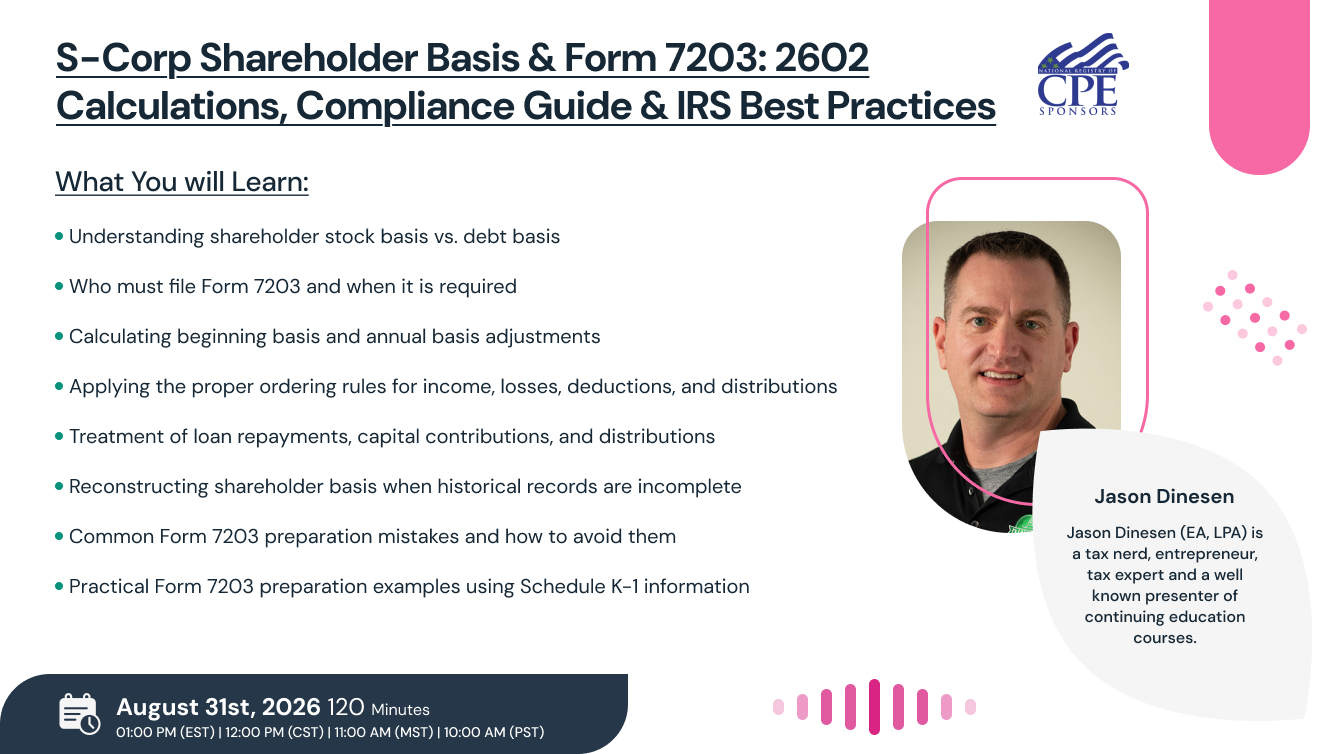
This practical webinar provides a step-by-step approach to understanding shareholder basis rules, preparing Form 7203 accurately, and handling complex scenarios encountered during tax preparation. Through real-world examples and case studies, participants will learn how to calculate basis, apply ordering rules, report shareholder loans, reconstruct basis records, and avoid common filing errors.
Areas Covered in this Training:
· Understanding shareholder stock basis vs. debt basis
· Calculating beginning basis and annual basis adjustments
· Applying the proper ordering rules for income, losses, deductions, and distributions
· Reporting shareholder loans and debt basis correctly
· Treatment of loan repayments, capital contributions, and distributions
· Loss limitation, at-risk, and basis limitation considerations
· Reconstructing shareholder basis when historical records are incomplete
· Who must file Form 7203 and when it is required
· Common Form 7203 preparation mistakes and how to avoid them
· Practical Form 7203 preparation examples using Schedule K-1 information
· Year-end planning strategies to preserve shareholder basis and maximize allowable deductions
· IRS examination trends and documentation best practices
Why Attend this Training:
Whether you're preparing returns for S-corporation shareholders or reviewing complex basis calculations, this webinar will help you strengthen your compliance process and improve reporting accuracy. You'll learn how to prepare Form 7203 with confidence, minimize common filing errors, manage challenging basis scenarios, maintain documentation that withstands IRS scrutiny, and confidently apply these concepts to real-world client engagements. Also, you’ll learn how to –
· Avoid costly shareholder basis reporting errors.
· Handle complex S-corp basis situations effectively.
· Reduce IRS examination risks through proper documentation.
· Gain practical guidance you can immediately apply during tax engagements.
Suggested Attendees:
· CPAs
· Enrolled Agents (EAs)
· Tax Preparers
· Tax Consultants
· Public Accountants
· Corporate Tax Professionals
· Controllers
· CFOs
· Financial Advisors
· S-Corp Owners
· Accounting Managers

Jason Dinesen
Jason Dinesen (EA, LPA) is a tax nerd, entrepreneur, tax expert and a well-known presenter of continuing education courses. Known for his sharp tax interpretations, he is one of the quickest to bring the analysis of the latest tax updates and IRS guidance to the professional community.
Jason has coached over 200,000 accounting, tax, and HR professionals on various topics of accounting, individual taxation, corporate taxation, professional ethics and much more. He has presented over dozens of webinars on Form 1099 (for 10 years on this subject!); marriage in the tax code; tax updates; the new Form W-4, payroll updates, filing status, tax credit and other issues relating to the modern-day household setting. He also teaches 2 classes at Simpson College, Individual Income Tax and Business Analytics.
Jason always had a knack for radio shows and has and regularly features as an anchor for Radio Iowa. He was born and raised in Iowa and has a degree in corporate communications from Simpson College in Indianola. He has a big family that includes his wife, two sons, 4 cats and 2 dogs. His other hobbies include being a season ticket holder to University of Iowa football.
NASBA -
CPE Credits = 2.0
“In accordance with the standards of the National Registry of CPE Sponsors, CPE credits have been granted based on a 50 minute hour.”
Standeagle is registered with the National Association of State Boards of Accountancy (NASBA) as a sponsor of continuing professional education on the National Registry of CPE Sponsors. State boards of accountancy have final authority on the acceptance of individual courses for CPE credit. Complaints regarding registered sponsors may be submitted to the National Registry of CPE Sponsors through its web site: www.nasbaregistry.org.
ACCREDITATIONS