Overview:
The U.S. Department of Labor (DOL) has issued a significant 2026 proposed rule regarding Independent Contractor classification under the Fair Labor Standards Act (FLSA). This proposal rescinds the 2024 rule and reintroduces a revised economic reality framework that may substantially impact how businesses classify workers as employees or independent contractors.
HR leaders cannot confidently classify workers as employees or independent contractors because the federal standard keeps changing — and misclassification carries severe financial and legal consequences.
This webinar provides a comprehensive breakdown of the 2026 proposal, key differences from prior rules, compliance risks, and practical steps organizations should take to mitigate worker misclassification exposure.
Areas covered in this Training:
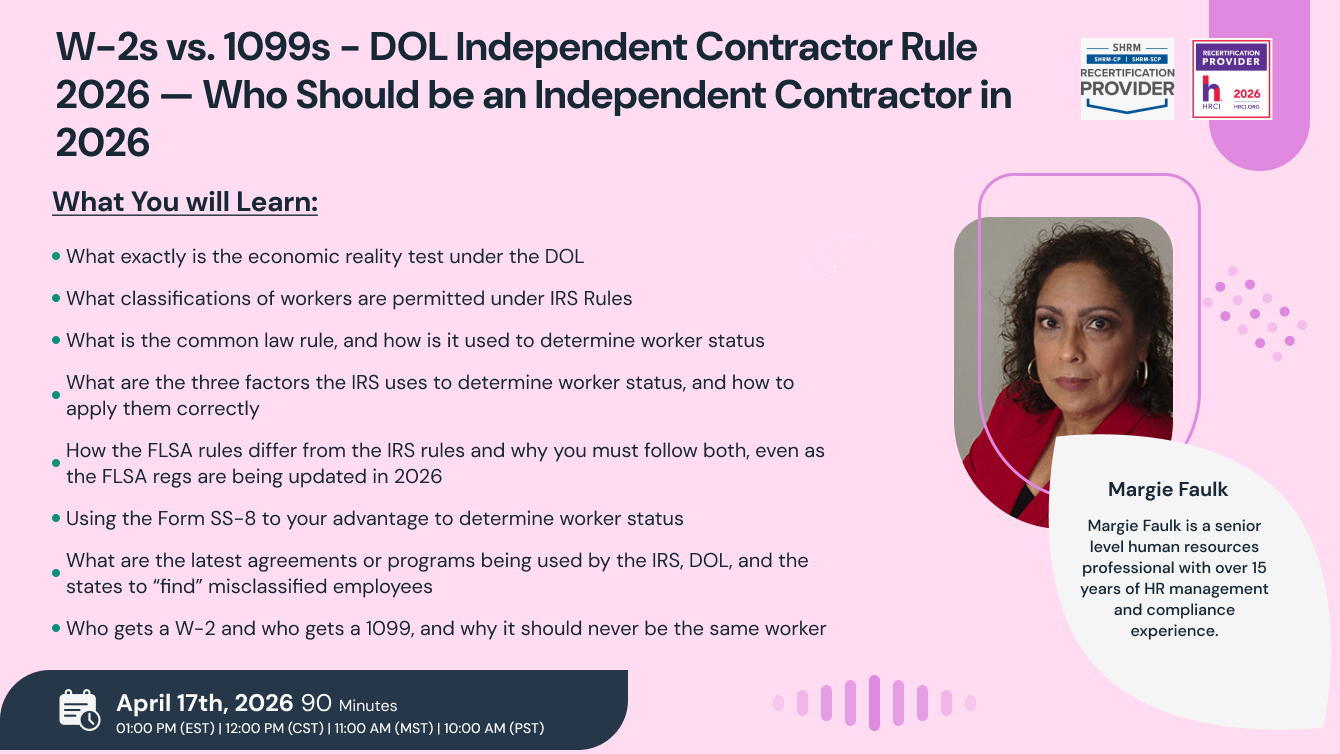
What just recently announced (02-26-2026), new (or old) criteria is the DOL now using to determine worker status
· What exactly is the economic reality test under the DOL
· What classifications of workers are permitted under IRS Rules
· What is the common law rule, and how is it used to determine worker status
· What are the three factors the IRS uses to determine worker status, and how to apply them correctly
· How the FLSA rules differ from the IRS rules and why you must follow both, even as the FLSA regs are being updated in 2026
· How does the state trump both the IRS and the FLSA on determining independent contractor status with the ABC test for SUI
· What are the latest agreements or programs being used by the IRS, DOL, and the states to “find” misclassified employees
· Using the Form SS-8 to your advantage to determine worker status
· Who gets a W-2 and who gets a 1099, and why it should never be the same worker
Who Attend this Training:
This webinar is essential for anyone responsible for worker classification, workforce flexibility, or compliance strategy:
· Business owners and executives - If your company relies on independent contractors, gig workers, or consultants, you need to understand how the proposed rule could affect your business model and risk exposure.
· HR professionals and HR business partners - If you are responsible for classifying workers, drafting contractor agreements, conducting audits, or advising leadership on compliance risk.
· General counsel and compliance leaders - If you need to evaluate litigation exposure and understand how the proposed “core factors” test differs from the 2024 rule.
· Payroll and workforce administration professionals - If worker classification impacts overtime eligibility, recordkeeping, tax reporting, or FMLA determinations.
· Staffing, franchise, and contractor-heavy employers - If your organization depends on flexible workforce structures, and you need clarity on what the DOL’s proposed rule means for your operations.
· Managers and operational leaders who engage contractors directly - If you supervise or work alongside independent contractors and need to understand how control, profit opportunity, and actual practice affect classification status.

Margie Faulk
Margie Faulk is a senior level human resources professional with over 15 years of HR management and compliance experience. A current Compliance Advisor for HR Compliance Solutions, LLC, Margie, has worked as an HR Compliance advisor for major corporations and small businesses in the small, large, private, public, Non-profit sectors and International compliance. Margie has provided small to large businesses with risk management strategies that protect companies and reduces potential workplace fines and penalties from violation of employment regulations. Margie is bilingual (Spanish) fluent and Bi-cultural. Margie’s area of expertise includes Criminal Background Screening Policies and auditing, I-9 document correction and storage compliance, Immigration compliance, employee handbook development, policy development, sexual harassment investigations/certified training, SOX regulations, payroll compliance, compliance consulting, monitoring US-based federal, state and local regulations, employee relations issues, internal investigations, HR management, compliance consulting, internal/external audits, and performance management. Margie’s unique training philosophy includes providing free customized tools for all attendees. These tools are customized and have been proven to be part an effective risk management strategy. Some of the customized tools include the I-9 Self Audit. Correction and Storage program, Ban the Box Decision Matrix Policy that Employers can provide in a dispute for allegations, Family Medical Leave Act (FMLA) Compliance Guide, Drug-Free Workplace Volatile Termination E-Book and other compliance program tools when attendees register and attend Margie’s trainings. Margie holds professional human resources certification (PHR) from the HR Certification Institution (HRCI) and SHRM-CP certification from the Society for Human Resources Management. Margie is a member of the Society of Corporate Compliance & Ethics (SCCE).

SHRM -
Standeagle is recognized by SHRM to offer Professional Development Credits (PDCs) for the SHRM-CPSM or SHRM-SCPSM. This program is valid for 1.5 PDCs for the SHRM-CPSM or SHRM-SCPSM. For more information about certification or recertification, please visit - portal.shrm.org.
HRCI -
This webinar has been approved for 1.5 HR (General) re-certification credit hours toward California, GPHR, HRBP, HRMP, PHR, and SPHR recertification through the HR Certification Institute.
The use of this seal is not an endorsement by the HR Certification Institute of the quality of the activity. It means that this activity has met the HR Certification Institute’s criteria to be pre-approved for re-certification credit.
ACCREDITATIONS